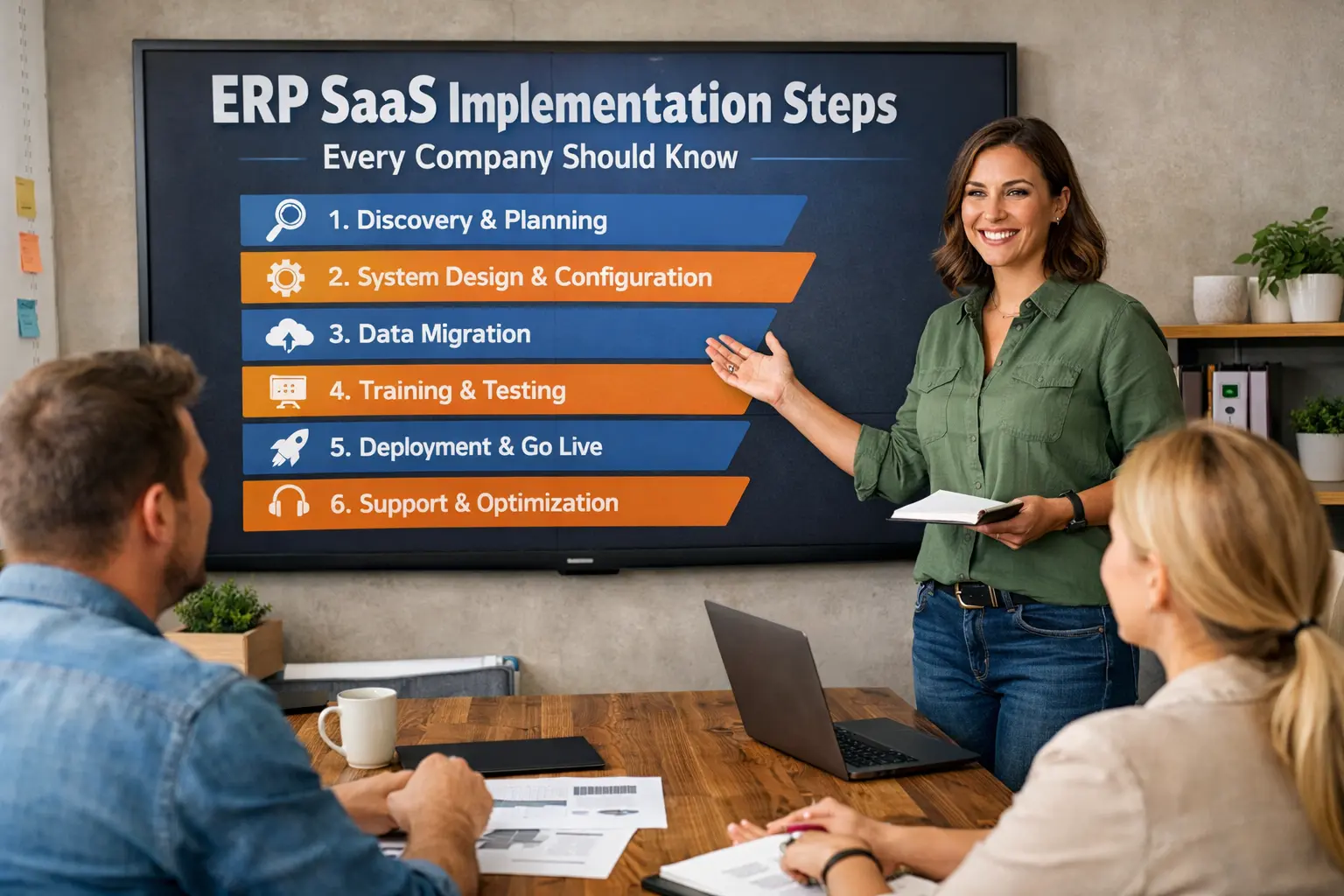
ERP SaaS Implementation Steps Every Company Should Know
Enterprise Resource Planning (ERP) systems have become the backbone of modern organizations. Businesses today manage complex operations including finance, human resources, supply chains, inventory, procurement, and customer relationships. Traditional ERP systems once required massive infrastructure investments and long deployment timelines. However, the rise of ERP SaaS (Software as a Service) has completely transformed how companies adopt enterprise software.
ERP SaaS solutions are cloud-based platforms that allow companies to access enterprise applications through the internet without installing on-premise infrastructure. Organizations can deploy ERP software quickly, scale resources as needed, and reduce IT maintenance costs. As digital transformation accelerates globally, ERP SaaS adoption continues to rise across industries including manufacturing, retail, healthcare, logistics, finance, and e-commerce.
Despite its advantages, ERP SaaS implementation requires careful planning and strategic execution. Many businesses fail to achieve the expected return on investment because they underestimate the complexity of ERP deployment. Successful ERP SaaS implementation involves structured planning, data preparation, user training, system integration, and continuous optimization.
This guide explains the essential ERP SaaS implementation steps every company should know to ensure a smooth and successful deployment.
Understanding ERP SaaS Implementation
ERP SaaS implementation refers to the process of deploying a cloud ERP system within an organization. Unlike traditional ERP installations, SaaS ERP platforms are hosted by cloud providers and accessed through web browsers.
Key benefits of ERP SaaS implementation include:
- Lower upfront investment
- Faster deployment
- Automatic updates
- Scalability
- Improved data security
- Remote accessibility
- Reduced IT infrastructure cost
- Better business analytics
- Real-time data insights
- Simplified system maintenance
Companies adopting ERP SaaS solutions often aim to improve business process automation, operational efficiency, decision-making, and resource management.
However, the success of ERP SaaS implementation depends on following a structured deployment strategy.
Step 1: Define Business Goals and Requirements
The first and most critical step in ERP SaaS implementation is identifying your organization’s goals and operational requirements.
Companies must clearly define:
- What problems the ERP system should solve
- Which business processes need automation
- Which departments will use the ERP platform
- What data must be integrated into the system
- What reporting and analytics capabilities are required
Key departments involved include:
- Finance management
- Human resource management
- Supply chain management
- Inventory management
- Procurement systems
- Customer relationship management (CRM)
- Sales management
- Project management
Conducting a business process analysis helps identify inefficiencies and areas that need automation.
This stage also involves defining ERP performance metrics, KPIs, and success benchmarks.
Step 2: Choose the Right ERP SaaS Vendor
Selecting the right ERP SaaS provider is crucial for long-term success. Businesses should evaluate multiple ERP platforms based on functionality, scalability, pricing, security, and support.
Popular ERP SaaS vendors include:
- SAP Cloud ERP
- Oracle NetSuite
- Microsoft Dynamics 365
- Odoo ERP
- Acumatica Cloud ERP
- Epicor ERP
- Sage Intacct
When choosing an ERP SaaS vendor, consider the following factors:
- Industry-specific ERP features
- Cloud infrastructure reliability
- Integration capabilities
- Customization options
- API availability
- Security compliance standards
- Vendor support services
- Subscription pricing model
- Data backup and recovery options
Choosing a scalable ERP SaaS solution ensures the system can grow alongside the business.
Step 3: Build an ERP Implementation Team
ERP implementation requires collaboration across multiple departments. Companies must create a dedicated ERP implementation team responsible for planning, deployment, and monitoring.
Key roles in the ERP implementation team include:
- ERP project manager
- IT specialists
- Business analysts
- Department representatives
- Data migration experts
- ERP consultants
- Vendor support specialists
The ERP project manager coordinates tasks, tracks progress, manages timelines, and ensures all stakeholders remain aligned with project goals.
Clear communication and collaboration across departments are essential for successful ERP deployment.
Step 4: Map Business Processes
Before deploying ERP SaaS software, companies must analyze existing workflows and redesign processes where necessary.
ERP implementation often requires business process reengineering (BPR).
Process mapping helps organizations:
- Identify redundant processes
- Eliminate manual tasks
- Improve workflow efficiency
- Standardize operations across departments
- Align processes with ERP capabilities
Key business processes typically mapped during ERP deployment include:
- Order management
- Procurement workflow
- Inventory tracking
- Financial accounting
- Payroll management
- Asset management
- Production planning
- Customer service operations
This step ensures the ERP system supports optimized workflows rather than outdated processes.
Step 5: Data Migration and Data Cleaning
One of the most challenging ERP SaaS implementation steps is migrating existing business data into the new system.
Organizations often maintain data in various legacy systems such as spreadsheets, databases, and outdated software platforms.
Before migration, companies must perform data cleansing to remove:
- Duplicate records
- Incomplete information
- Outdated customer data
- Inconsistent product codes
- Invalid transactions
Accurate data migration ensures the ERP system provides reliable analytics and reporting.
Data categories typically migrated include:
- Customer data
- Vendor records
- Inventory databases
- Financial transactions
- HR employee records
- Sales history
- Purchase orders
Testing data migration in staging environments helps prevent system failures during live deployment.
Step 6: ERP System Configuration
After selecting an ERP SaaS platform and preparing data, the next step is configuring the system according to business needs.
ERP configuration involves customizing settings such as:
- User roles and permissions
- Workflow automation rules
- Financial accounting structures
- Inventory categories
- Product catalogs
- Pricing rules
- Tax configurations
- Reporting dashboards
ERP SaaS platforms often provide low-code customization tools allowing businesses to tailor workflows without extensive programming.
Proper configuration ensures that the ERP system aligns with company operations.
Step 7: Integration With Existing Systems
Many organizations rely on multiple software platforms such as CRM systems, accounting software, e-commerce platforms, and analytics tools.
ERP SaaS implementation requires integrating these systems to ensure seamless data exchange.
Common ERP integrations include:
- CRM platforms
- Payment gateways
- HR management systems
- Supply chain platforms
- E-commerce websites
- Business intelligence tools
- Marketing automation software
ERP APIs and middleware solutions help connect different systems and maintain real-time data synchronization.
System integration eliminates data silos and improves decision-making.
Step 8: Testing and Quality Assurance
Testing is a critical phase before launching the ERP SaaS system.
Companies must conduct multiple testing stages including:
- Functional testing
- Integration testing
- Data validation testing
- Security testing
- Performance testing
- User acceptance testing (UAT)
Testing ensures that the ERP system operates correctly and all modules function as expected.
Key testing areas include:
- Order processing workflows
- Inventory updates
- Financial reports
- Employee payroll processing
- Customer order tracking
Identifying and fixing issues during testing prevents costly disruptions after deployment.
Step 9: Employee Training and Change Management
ERP implementation often requires employees to adapt to new workflows and digital tools.
Without proper training, employees may resist adopting the new system.
Organizations should conduct structured ERP user training programs that include:
- Hands-on software training
- Video tutorials
- User manuals
- Department-specific workshops
- Role-based system training
Change management strategies help employees transition smoothly to the new ERP platform.
Companies should encourage feedback and provide continuous technical support during the transition.
Step 10: ERP Go-Live Deployment
After successful testing and training, companies can proceed with the ERP system launch.
ERP go-live strategies include:
- Phased implementation
- Parallel deployment
- Big bang deployment
Phased implementation introduces ERP modules gradually across departments.
Parallel deployment runs old systems alongside ERP temporarily to reduce risk.
Big bang deployment switches all systems to ERP simultaneously.
Companies must carefully choose the approach that best suits their operational complexity.
Step 11: Post-Implementation Support and Optimization
ERP SaaS implementation does not end after deployment.
Continuous monitoring and optimization are essential for long-term success.
Post-implementation activities include:
- Performance monitoring
- System updates
- Bug fixes
- Security patches
- Workflow improvements
- User support services
Businesses should regularly review ERP analytics dashboards to identify opportunities for improvement.
Ongoing ERP optimization helps organizations maximize ROI and improve operational efficiency.
Common Challenges in ERP SaaS Implementation
Although ERP SaaS solutions simplify enterprise software deployment, companies may still face challenges such as:
- Data migration errors
- Integration issues
- Poor user adoption
- Inadequate training
- Unrealistic timelines
- Lack of executive support
- Budget overruns
Proper planning and experienced ERP consultants can help overcome these challenges.
Future Trends in ERP SaaS
The future of ERP SaaS continues to evolve with advanced technologies including:
- Artificial Intelligence in ERP
- Machine learning analytics
- Predictive business intelligence
- Blockchain supply chain tracking
- IoT integration with ERP systems
- Hyperautomation in enterprise workflows
Modern ERP SaaS platforms now offer AI-driven insights, automated forecasting, and intelligent process automation.
These innovations will further transform enterprise management and digital transformation strategies.
Conclusion
ERP SaaS solutions have revolutionized how businesses manage operations, data, and workflows. Cloud-based ERP platforms offer scalability, cost efficiency, real-time analytics, and remote accessibility that traditional ERP systems cannot match.
However, successful ERP SaaS implementation requires a well-structured approach. Companies must define clear goals, select the right ERP vendor, prepare data carefully, configure systems properly, integrate existing tools, and train employees effectively.
By following the ERP SaaS implementation steps outlined in this guide, organizations can minimize risks and maximize the value of their ERP investment.
In an increasingly digital business environment, ERP SaaS platforms will continue to play a vital role in improving efficiency, productivity, and strategic decision-making across industries.
Businesses that implement ERP SaaS correctly gain a competitive advantage through streamlined operations, better insights, and faster innovation.